Quantum Advantage Challenge (Updated)
Beat the quantum computer to win 0.25 Bitcoins
PRIZE: 0.25 BITCOINS ($20,198)
Completed
📣 Update on the Quantum Advantage Challenge
Our friends at IBM found a classical heuristic approach to our current implementation of HQAP circuits.
- You can read more about their novel and impressive algorithm here.
- This is great news as we are witnessing a battle of classical vs quantum algorithms real time.
- The Open Challenge will be back once we improve our implementation of HQAP circuits.
🚀 Quantum Advantage Challenge
Welcome to BlueQubit’s Quantum Advantage Challenge — a challenge set up to test weather regular computers can beat quantum computers.
Your mission is to crack a real Bitcoin wallet containing 0.25 BTC 💰 locked behind a series of peaked-circuit puzzles 🔐.
These puzzles are carefully constructed instances of peaked circuits - solvable on a quantum computer in under two hours ⚡ (as shown in our article) but very hard to solve on regular computers.
The challenge is straightforward:
Can anyone beat a quantum computer with classical computers?
If yes, they can take home the 0.25 BTC prize 🚀
🪙 Bitcoin Prizes
A fully funded wallet with 0.25 BTC will remain publicly visible at the challenge wallet address
The 256-bit private key of that wallet is hidden across 5 problems of increasing difficulty e.g., 36 bits, 52 bits … total of 256 bits.
Each problem corresponds to solving one peaked circuit.
Solve all five → assemble the key → the Bitcoin Wallet is yours. 🎉
🎯 Solving Peaked Circuits
Peaked Circuits will be posted in .qasm format in the Problems tab above. Each circuit sets up a specific quantum state. Hidden within that state is a single bitstring that appears with high probability.
Solving a peaked circuit means finding this bitstring!
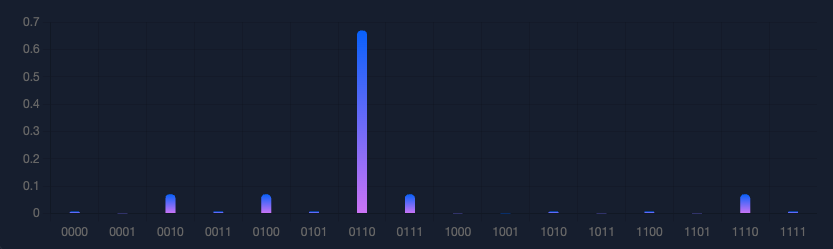
In the example above, 0110 is the peak bitstring as it has comparatively much higher probability to be measured than all the other bitstrings. And below you can find the .qasm file that prepared this state:
OPENQASM 2.0;
include "qelib1.inc";
qreg q[4];
x q[0];
x q[3];
ry(0.8*pi) q[0];
ry(0.8*pi) q[1];
ry(0.8*pi) q[2];
ry(0.8*pi) q[3];
📜 Submission rules
To submit a solution bitstring use the “submissions” tab above.
You’ll need to explain how you solved the circuit so we can verify that it was done classically — not on a quantum computer.
You can use any classical methods or hardware you like — GPUs, CPUs, AI Agents, Internet — but each circuit must be solved in under two hours ⏱️.
To ensure fairness and prevent quantum-assisted shortcuts:
- We may request additional technical details 📝 about your solver.
- We may ask you to solve a similar instance live at a scheduled time.
- Once approved you will progress to the next problem. If you manage to solve all 5 problems, we’ll send you the salt 🔑 needed to reconstruct the final private key:
BTC Wallet Private Key = Combined 5 Peak Bitstrings ⊕ Salt
The salt ensures the solver of the last problem cannot instantly drain the wallet — only verified classical solvers can.
📚 Peaked Circuits in a Nutshell
“Peaked circuits” are pre-constructed quantum circuits with a non-uniform distribution of measurement outcomes. They are designed in a way that one particular bitstring has a higher probability than others, e.g. O(1) as opposed to exponentially small amplitude.
They were introduced by Scott Aaronson as a way to achieve verifiable quantum advantage. Carefully crafted peaked circuits look like random circuits - like the one used by Google in their benchmark that would take supercomputers septillion=10²⁵ years to replicate. However, unlike random circuits - peaked circuits are much easier to verify: all you need to do is to run them on a quantum computer and verify you get the correct hidden bitstring!
↔️ Similarities with the RSA challenge
- The inspiration for this challenge comes from the RSA Factoring Challenge in 2000s
- From 1991 to 2007 RSA Laboratories were publishing coprimes (products of two prime numbers) s of increasing difficulty to see who can factor them
- While some of the first coprimes were factored - eventually none was “cracked”
- Thus eventually the scientific community built consensus that this problem is actually really hard - so much so that we built the world’s cryptography on top of that problem.
- Similar to the RSA Factoring Challenge, we want to use the BlueQubit Quantum Advantage Challenge to eventually build consensus about quantum computers solving problems that are hard for regular computers.
💬 Frequently Asked Questions
1. Who can I contact if I have questions?
You can email qac@bluequbit.io
2. Is there a Discord server about this challenge?
Yes you can join the BlueQubit Discord server
3. Is there a place to practice solving Peaked Circuits?
Yes you can find easier peaked circuits and practice on them in our Peaked Portal.
4. How do I claim the 0.25 bitcoin prize?
The 0.25 prize BTC is locked in this wallet.
The 256 bit private key of the wallet is hidden inside the 5 problems (peaked circuits).
5. How many problems are there total?
There will be total of 5 problems. You will only see the first one at the start, and each time you will need to solve one to unlock the next problem.
6. How are the 256 bits of the BTC wallet private key hidden in the 5 problems?
Each problem encodes a peaked circuit that encodes a bitstring.
- Problem 1: 36 qubit circuit encodes the first 36 bits of the private key.
- Problem 2: 52 qubit circuit encodes the next 52 bits of the private key.
- …
- Problem 5, n qubit circuit encodes the last n bits of the private key,
To find the final private key you need to combine the peak bitstrings and the salt (you will be given the salt after solving all 5 problems):
BTC Wallet Private Key = Combined Peak Bitstrings ⊕ Salt